With digital purchases becoming the largely de facto way to purchase games, sales have skyrocketed. Whilst some still prefer to own an actual product (specially coded onto a plastic disc of varying storage capacities) that is also fueled by limited edition collectors specials (usually with bonus goodies) and some discussion of this also points to the continued preservation of games. Most of the time games are now downloaded at a button click. Continuing expansion of digital infrastructures globally, has meant faster and easier access to games whether it is by 3G and 4G technology with increasing possibilities with the slow rollout of 5G, or increasing dispersion of fibre-optic cables.
This has come with varied problems however. As far back as 2012, Steam sales have been noted as harming the game development community by damaging the long term value of the brand or as put by the CEO of EA a cheapening of intellectual property. Though this is largely opinion based and not compared to sales figures, not to mention the inherent bias in both interviews as both storefronts (GoG.com and Origin respectively) were possible competitors to Steam at the time.
Steam Libraries have a tendency to increase exponentially with sales
Some of the claims are partially true, as waiting for a sale is only a matter of a few months or so, (and even less with increasing world wide holidays such as the Chinese Lunar New Year gaining traction offering reduced time between sales) and gamers have even more discounts to look forward to. However there is another effect that I couldn’t find discussed until two years later, that points to how sales encouraged growth of players, whilst warning that it caused initial communities to be smaller, though long term this seemed to even out as many developers pointed to long term sales for their games that gave them “healthy revenue boosts”.
However for us as gamers, Steam sales are massive contributors to the backlog of games. It gives us the opportunity to experience games as a medium more widely, when you take a chance on that niche, bizarre indie game that you otherwise may not have bought, or let you purchase two expensive AAA games rather than one, since you were trying to stretch your budget as far as possible.
Steam sales are massive contributors to the backlog of games. It gives us the opportunity to experience games as a medium more widely
Other culprits to increase ones backog include gaming bundles such as those from Fanatical or Humble Bundle, whose Humble Choice offers select games every month at a very attractive subscription price and the added bonus of donating to charity. Who have by and large seemingly avoided the ire of the gaming press.
Another more quiet culprit is the issue of regional pricing. This may not be a large factor for gamers in 1st World countries, but it makes all the difference for those of us living in the 3rd world. My GoG library is largely inhibited by the fact that they do not allow for regional pricing, which makes Steam, Epic and even Humble Bundle far more attractive prospects. Being charged Pound sterling on the uPlay store or directly converted prices on Origin make them far and away the most expensive options. The same held true whilst I worked in China, where games were even more cheaply priced than in my native South Africa. Though regional pricing is not without its detractors as well, with concerns being raised around geoblocking and discrepancies in pricing.
My GoG library has had an extensive increase with increased integration provided by the new Galaxy client
Despite all of these controversies and debates, many of which centre around economics, and accessibility of gaming as a world-wide phenomena, many gamers’ backlogs continue to grow. Which begs the question… how to manage continuously increasing inventories.
Which begs the question… how to manage continuously increasing inventories.
Prior suggestions have included working out the time to beat various games using sites like HowLongtoBeat or organising your Steam library into played, unplayed, DNF (Did Not Finish) or current. That is even easier now with Steam’s (and GoG’s) new library management tools.
Steam itself has also suggested ways for players to play old games, from its mini events such as the SpringCleaning event that included badges entitled “Clear the Backlog”, “Nostalgia” “Can’t Wait” and “Blast from the Past”. In addition they’ve just unveiled the Play Next Experiment in the Steam Labs, designed to recommend games you have not yet played from your backlog.
Narrative and puzzle games seem like appropriate recommendations
Other ideas for mastering the backlog come from a few friends. One of which is to tackle a larger more time intensive game whilst playing shorter ones alongside it.
A Game You’re Eager to Play But Have Not Yet Started
Disco Elysium has been critically hailed by many, and its dialogue systems and opportunities look absolutely incredible. Although I don’t particularly relish the general nihilistic tone of the game, I do look forward to seeing exactly how their systems have developed opportunities for roleplaying.
A game you’ve started several times but haven’t yet finished.
I actually don’t have any titles for this category. I finish all the games I start, mainly because I’m on a mission to review every game in my library, which means in order to review them, completion is required. Even if I leave them on hiatus for a while, I end up resuming from where I left them rather that restarting.
The most recent addition to your library
Project Warlock comes courtesy of Humble Bundle Choice for February. It’s an old fashioned FPS shooter, that is vaguely reminscent of the old Heretic and Hexen games. I’m terrible at FPS games but did have fun exploring the old level designs and castles of Hexen, so hope that this will give me a ‘blast’ of nostalgia. It doesn’t have an elven protagonist though as Heretic did, so I may not enjoy it quite as much!
The game which has spent the most time on your backlog
Dungeon Siege III was purchased in 2013 as a part of a Dungeon Siege pack, as I slowly converted my physical game library over to a digital one. This was mainly due to the fact that I ended up not having a settled home for many years, which is prohibitive against large book or gaming libraries. Slowly over the years I’ve built up my backlog to be primarily games I had previously owned and so I picked up the Dungeon Siege pack. I had played both the original Dungeon Siege as well as Dungeon Siege 2, but never had the opportunity to play the third. Partly because I had grown bored of aRPGs at that stage and partly because it received lacklustre reviews. I replayed Dungeon Siege last year, and temporarily started Dungeon Siege 2 after tweaking it to run on a modern system, however still haven’t completed it in order to play the third and final game in the series.
The person responsible for adding the most entries to your backlog
This would be myself since my relatives are fairly disapproving of gaming, seeing it as an escape from reality (it is) and something I retreat to at difficult times, which they then blame as causing the difficult time. Other factors such as depression or just the general society in which I live were not seen as exacerbating factors, although with the declining economy, there has been some mitigation, as well as the incredibly difficulty of finding work against affirmative action policies when applied against minorities, to exclude them. Yet persistence pays off, and work can be found, even if it’s not the skilled work I’m fully trained for. It does however allow me to freely indulge in the occasional splurge on games, though with what global gaming trends hold as well as the junk status of our economy, the future is likely not so prosperous. But while I can, I will add games to tide me over the dark times ahead (and most literally dark times, as our electrical power outages are consistently being increased)!
For more old games, I will replay at some point as well as more modern titles I still have to tuck into, you can browse my Steam Library. I’m planning to tackle quite a few RPGs alongside the numerous HoGs that are waiting to be reviewed. This includes classic titles like Baldur’s Gate I & 2 EE, to see how much more I can appreciate them now, with a few years of gaming behind me, years that have changed and reformed the way I view games, alongside some extra worldly wisdom, from having traveled and become a …semi-responsible adult.
The high seas beckon, as the Watcher of Caed Nua finds them-self adrift at sea… yet the Watcher is not unwatched. For the god of death, Berath, seeks to use The Watcher towards her own ends.
The first Pillars of Eternity was an immense disappointment when I played it. The world building and overall story were interesting, yet the companions felt stilted and the narrative was continuously interrupted by kickstarter self inserts. As much as it was a nice idea in theory to have so many diverse voices appearing in the game, in practice it distilled and weakened the overall world and frayed the themes of the game.
Being the desperate crpg player chasing after a Planescape: Torment high, I did however purchase Deadfire, despite not being particularly interested in pirates, nautical adventures and only after a vague sense of “treasuring” the ambition of the first game more than truly enjoying it.
Deadfire was thus an incredibly welcome surprise. The graphics are slightly overhauled with additional lighting and spell effects. This is noticeable in the very first area where a rainbow dances over a waterfall concealing a cavern. And was further validated by the delicate animations that bring each character to vivid life, whether it be flexing their water shaping skills, or scratching an itch in an… unmentionable area. The landscapes themselves evoke the Carribean, but with just enough innovation to still feel exotic, with Adra taking the place of coral to form reefs and shoals. Whilst exotic fruits and berries form the basis of various local cuisines. These little hints of the fantastical were present in the first game as well, but with the unusual setting they are even more apparent in Deadfire, and create an environment of discovery that was previously captured in games like The Elder Scrolls III: Morrowind.
Berkana’s Orrery
As tropical as the environments are, the game doesn’t shy away from more graphical effects in combat as well. Spells are the most gorgeous to see, with bright neon colours dancing about the screen, whilst insidious cloud effects partially obscure the combatants. Even the fighters are well realised as they steady themselves before a dash attack, and launch themselves on their enemies. Critical hits even have a kill cam feature where the game momentarily slows down time, before zooming in on the action further. The slow down however was rather frustrating as the combat wouldn’t flow as smoothly after, and the loss of framerates at such times was immensely frustrating. Some of the more demanding areas, had some noticeable drops in framerate, particularly where there was advanced wind or water effects that caused shifts in light, or sand particles to obscure the camera.
At times when the action on screen was particularly frenetic, the UI certainly came to the fore. Most information is readily available and many of the pop up menus are contextual which is helpful. The game does highlight figures if you linger over them with the mouse and an information screen will also pop up giving general details such as resistances, current effects and a generalised statement of health.
And the narrative whilst still based in its pirate theme, thankfully expanded far beyond that.
Narratively the game attempts to wear many hats, it wants to be a postcolonial deconstruction of colonial economics, a rollicking marine adventure ala Robert Louis Stevenson, by way of Pirates of Penzance and a high fantasy RPG that delves into existentialism, the nature of the divine and at times even ecological terrorism. This kaleidoscope of influences collide into a mess of genres and tropes. A cohesive theme is lost in favour of attempting to straddle various genres and their requisite themes. Whilst this slew of influences lends the game it’s diversity of choice it also lessons the impact of any particular message or thought the game might have, even if it does have some fantastic shanties.
We’ll rooooooooll the old berath’s wheel along and we’ll all hang on behind!
Foremost of all of these narratives is the factional alliances you can make. The Huana are the natives of the isles. Initially they may seem the most sympathetic to modern audiences, however the strict rigidity of their caste system and propensity to suppress social mobility in their own population is part of what causes their lack of ability to develop and is a large cause behind their social and economic stagnation which is what places them at the feet of foreign powers and even those powers that are only emerging as a result of the regional conflicts.
A chance to settle trade disputes… or start them
The Principi are as such a lawless faction governed by their own piratical code, that swings along the lines of “might makes right”. They are the most piratelike of the factions and at times it felt as if the game was most sympathetic to them. They have their own internal conflict, involving the seizing of slaves and selling them on for profit that causes an internal schism and power struggle. As buccaneers and freebooters they stick, lamprey like, to the various economic thoroughfares of the Deadfire archipelago seeking to exploit weaknesses and undermine inefficient bureaucracies. Their penchant for chaos does have a few redeeming features, as they actively subvert corrupt social structures as Neketaka (the primary city of the regions) lower markets. But they do this not from any compassion for misfortune but for the sake of individualism that results in anarchy.
Opposing this anarchy yet seeking to use it for their own ends are the economic policies of the Valian’s trading company. Seeking to expropriate valuable resources at the most efficient price possible they seek to reduce the cost of their scientific funding of animancy. The very same animancy from the first game that lead to some of the kiths greatest achievements as well as being incredibly harmful to the ecological state of the world, not to mentioning engendering the metaphysical crises that drives the primary narrative of the game. As expropriators they bring economic prosperity and to a limited extent social upliftment due to the benefits of their knowledge, and sciences, but sadly the game never truly explores the sustainability of their practice.
More coveted than gold, Adra is the natural resource for which the factions fight
The Royal Deadfire company on the other hand is largely concerned with long term viability. They are colonisers in the most general sense. They seek to dominate whether it’s via military prowess, new engineering feats or through remolding the defects of Huana society to gain political advantage. The game skirts away from racism and eugenics here to establish that the Huana are considered close to the Rauatai and so deserve the imperialistic improvements that they can bring. Superficially the Rauatai are there as benevolent arbiters of the indigenous Huana culture.
These conflicting factions form the backbone to the God’s secular question, of whether humanity itself is able to overcome its differences and act in unison to confront a global crisis. Eothas, in the aspect of Gaun, is simply the progenitor of this crisis and Woedica who is the most antagonistic and cynical about the nature of the kith, seems to be the most vindicated by the results of your actions at the end of the game. This is largely due to the fact that the game offers no true resolution to the factions. There is no armistice, in fact it fails rather dismally, sometimes as a direct result of the players intervention, such as two factions storylines that result in you destroying the powder house of the Royal Deadfire company. The failure to create solidarity is justification of Woedica’s views. Even the party itself is split once certain factions are chosen with even the Watcher’s closest companions abandoning them at the penultimate moment.
Whilst the faction endings are at once rather underdeveloped (after all two factions resulting in the same scenario as a penultimate quest speaks to lack of resources to develop more broad scenarios), it doesn’t assuage the results of the player causing the unity of the individual faction they choose: whether it is deposing a pirate lord, or maintaining his power, allowing for a queen to continue to rule over a caste system that creates systemic inequality, or allowing a merchant to continue to hold his corrupt bureaucracy or fall in favour of his more ruthless and exploitative underling. In these smaller triumphs the narrative does hint towards Eothas’s idealistic view of human nature.
But these moments fall short of the absolute failure to actually bring about a more amicable and stable political situation to the Deadfire. The political tensions are done away with in acts of braggadocio and the jingoistic triumph of the faction you choose. The consequences for choices here are clear, and the central importance of your character is never in doubt as the traditional fantasy protagonist that sways the fate of nations. Yet in its larger narrative solidified in the titanic Eothas the game reverts all of this, clearly playing upon the more passive nature of being a “watcher” rather than an active participant.
Gods, even the artificial gods of Eora, are clearly considered too much for the protagonist to handle. The game steers directly away from the power inherit within a protagonist to indicate, despite being a Watcher, that your abilities are mundane. This is done repeatedly; from tête-à-têtes with the ‘Prevailing Powers That Be’ to encounters with archmagi that reveal their superiority over the player character. Even the trials against gods take place as gauntlets to be overcome rather than climactic confrontations, which is all the more obvious in the DLC content. It’s a realism that is surprising in such a game, and has been the source of many complaints, not least amongst them the inability to duel Eothas at the finale, which many felt robbed players of a final boss fight. This lack of pandering to a power fantasy is a break with the more conservative tradition in cRPGs that gives the player godlike potentiality. In the case of Eora, this lack of status given to the Watcher makes some sense, after all the Gods are created by animancy and a mechanical apotheosis would require some similar circumstance to be undergone, but with Eothas’ intentions for the wheel it seems such pursuits might be permanently unattainable. Instead the game reconfirms in its finale your ultimate status as kith – mortal and mundane. In this the games ultimately cynical outlook on kithkind (humanity) is revealed.
Beware when you play cards with death…
From the very beginning Berath informs you of the inevitability of your journey’s end. That in pursuing Eothas you will ultimately fail to prevent his mission. This is reconfirmed throughout the game. Narrative tension is lost from the outset as failure is inevitable, and even exploration of the unknown and the mysteries it holds does not lend any motivation, after all the trajectory of a titanic Adra statue is not difficult to determine. Instead the game relies on the factional tensions and the alliances you build with them to create interest and conflict. The burden of the storytelling lies firmly upon the ability of the roleplaying, roleplaying that is hindered by a mechanical system that can never compare to the freeform play of tabletop or the statistical methods that optimize the play of powerful builds that can overcome the most difficult strategic challenges.
For all that is a major criticism, the combat in Deadfire is immense fun. Breaking from the DnD ruleset and it’s min-maxing elements, leaves room for experimentation with builds. Many things are still the same, a dexterous wizard is still a primary but might (physical strength) is a positive boon as well, because it directly translates to the damage output of spells. Likewise unconventional melee builds are possible as well, with fighters being able to include intelligence as a stat for Defensive fighters due to its bonuses to AoE. As much as the game does allow for such unconventionality though on harder difficulties it still favours more traditional builds.
Those harder difficulties are more difficult than the first game. There is still some issue with level scaling, as per the first game, were later game encounters became to easy for large parties, requiring the game to upscale the difficulty. It is nowhere near as noticeable here though, and the overall development is well handled. The quests themselves don’t necessarily increase in importance however. Some of the later stage quests are incidental encounters, that neither add to the overall story, though one might consider an imp uprising to be possible in future titles (if they ever come to be). Companion Quests however tie in directly to the main plot, whilst adding characterisation. The game hints at which characters to use for which quests by including their portraits alongside the quest description in the journal. Special dialogue is usually available adding to the players understanding of events, as well as causing party alliances or disputes. Deadfire has a robust character system that encourages the party members to actively like or dislike each other. Aloth will constantly roll his eyes, in his best imitation of a petulant teenage girl at anything Serafen says, whilst Tekehu’s amorous adventures and nymphomaniac tendencies are laughed at by the selfsame Serafen. This causes more links and interconnections than just simple party based banter familiar in more normal RPGs that is purely based on character and not how well the characters are getting on. It’s a lovely feature though one that is questionably included considering how much extra work it must have required. Work that the game desperately needs elsewhere such as in ship exploration and combat.
Since Deadfire has a nautical theme, it’s unsurprising that the player is given a ship to steer about the sea. This is where factional alliances come into play. Depending on the colours you fly (your own unaffiliated, or factional) various ships will either ignore or attack you. Managing and outfitting your ship takes the place of usual keep management that was introduced from games like Neverwinter Nights 2. In addition Deadfire also has you manage the crew for your ship. The larger the ships and the more crew you have, the more food and water they will require. The game also introduces morale, keeping the crew happy and preventing them from mutinying will require either victories at sea or more expensive rations, usually of an alcoholic nature. Yet it never really feels like it amounts to that much. The travel distances of the Deadfire Archipelago are so small as to make most of the rationing and strategical planning to be redundant, and by the late stages of the game, the ships are easy money sinks, since the loot has improved immeasurably so that it’s easy enough to simply purchase up the rations required.
The triumph of the Useless Idiot!
Ship to ship combat is also relatively unrewarding. The combat is rather clunky and not visually realised but rather as descriptions of combat. The nautical terminology is easy to grasp and glosses for terms are provided, whether through icons or descriptions. Most of the time combat is usually simply advancing close enough whilst receiving as little damage as possible in order to board the ship, which then moves to normal ingame combat, which of course is the games strength. You can even simply attack directly as an option when engaging vessels bypassing the ship combat completely.
The other important aspects to ships is of course exploration. The ships crew gains experience in an additional levelling system, as they encounter new regions, sights and survive encounters. The islands themselves are marked on the map for you and a subquest encourages you to “colonise” the lands, naming them after your whim. However main quest locations are marked and can be sailed to directly without exploration. Since the islands are discrete landmasses, they don’t offer a feeling of scale when adventuring. They inevitably end up feeling more like once off encounters rather than integrated parts of a world. A place to tick off then continue adventuring. As such the wonder of discovery is inevitably lost to a list of check marks, something that the game tries to prevent with its detailed and inventive locales but never quite achieves. This is especially apparent when massive wonders are only reverted to textbox descriptions that can’t quite translate across the dual medium of the game as both text adventure and visual isometric world.
There are many fishermen’s tales of odd creatures in the Deadfire, not least amongst them tales of living trees.
Pillars of Eternity 2: Deadfire is overall an incredible game, with sound combat, an incredible interfactional storyline, but is let down by some very serious issues, such as the lack of intriguing exploration, feature creep that led to some interesting elements but that will only be for new games to explore meant that areas that required more development did not receive the budget or development time they should have. It is however still one of the finest RPGs ever made, despite the passive role it wishes the protagonist to adopt, that leads to weaknesses in the narrative. It is kept aloft by its fantasy and inventiveness that promise future developments for the genre, and continues to carry the standard of its predecessors Baldur’s Gate and Icewind Dale.
Score ~8/10~
Pros
Incredibly well written with lots of nuance
Companion dialogues and stat system is intriguing
Lots of complexity and customisability of companion builds
Detailed graphics that bring the world to life
Cons
The narrative is somewhat weak as it de-emphasises the role of the player character and shifts them to a passive role as “Watcher”
Please note this article focuses on some critical story elements and may contain a few spoilers for Pathfinder: Kingmaker
Pathfinder: Kingmaker like many RPGs offers a variety of outcomes to the events of its main story. Alignment choices, completion or incompletion of side-quests, decisions of governance, may exhibit immediate outcomes, or have an outcome in the ending slides of the game. Even nominal characters like Nyrd Zottenropple, have an impact on important events should you make the requisite choices. Yet none of this is unique, in fact it’s been done for years. As recently as Deadfire and as far back as Arcanum. As creative as Kingmaker is, and as varied as it’s choices are there is still one more unique way it approaches its storytelling that I haven’t seen in a game of this type before.
The primary focus of an epic fantasy RPG, as the genre implies, is the creation and fulfillment of your avatars life in the world. The game is played from a first person perspective with the player embodying the characters view point. We learn about the world and it’s events through the eyes of our avatar. And although mechanically we can pull the camera back for a 3rd person view in some RPG games (like Skyrim or Dragon Age) this is only a mechanical change, not a narrative shift, instead the narrative stays purely focused on something I call (for games) the singular perspective. This of course allows for the building of suspense for plot twists and removes an annoying omniscient (or partially omniscient narrator) from muddying the ‘text’ of the game keeping the player immersed in that delicate balance that is known as ‘suspension of disbelief’.
Yet this is also limiting. Where novels such as A Song of Ice and Fire, The Wheel of Time or Lord of the Rings can switch easily between characters and events in far-flung spaces, which vastly expands the scope of the world as they do it. Games however largely require the player to explore the world, revealing it slowly frame by frame focused upon the avatar. As such games lay importance upon the characters agency and this is somewhat to the detriment of a concept of a world that exists externally to the avatar.
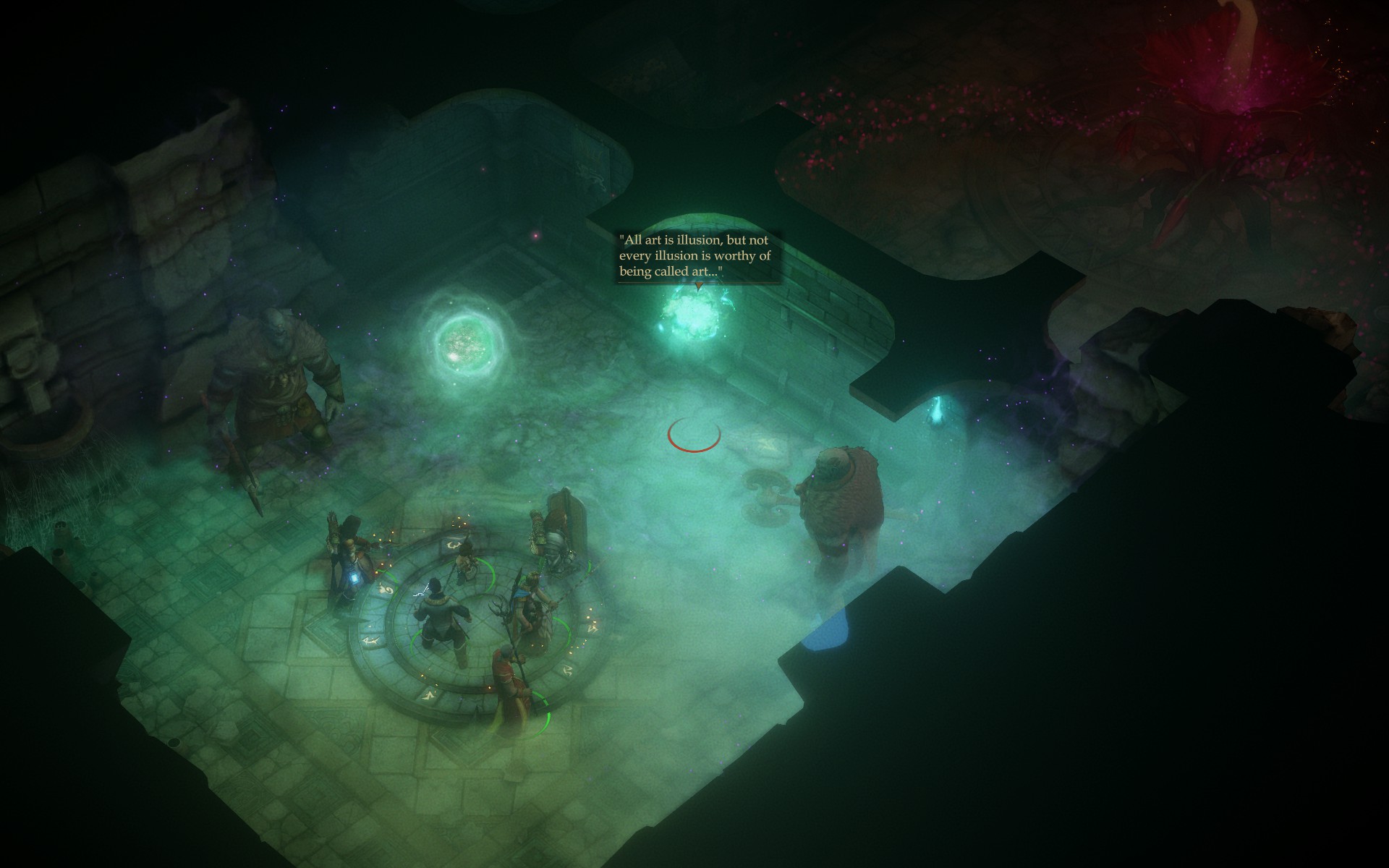
Not all illusions are art
Pathfinder: Kingmaker attempts to overcome this, with timed events that place pressure on the player to resolve them before they escalate. The world is filled with danger and wonder that both threatens and delights. The world has agency, important to the thematic elements of the plot, and it is unlike other RPGs in that this danger purely manifests as quests to resolve or monsters to slaughter. As nature, and time attempt to tear down the hard wrought community you attempt to build. These events that occur are revealed in the main quests as many media’s do, through insight from NPCs, most notably certain companions as well as through a villains monologue. Allowing the player to piece a timeline together after the fact, and discover the secrets and revelations of a forgotten past, the secondary type of exploration that games can offer.
The Varnhold’s Lot DLC offers a new approach, more closely allied to novels that switch character perspectives.
But these traditional methods are not the only technique Owlcat Games uses…
The Varnhold’s Lot DLC offers a new approach, more closely allied to novels that switch character perspectives. Running two characters in a single unified game is of course impossible, except Varnhold manages to achieve this by offering a secondary campaign that occurs in conjunction with the first campaign. Whilst the player character is exploring events in the Shrike Hills, the Varnhold Barony is expanding into the Dunsward and developing alongside your own kingdom. It offers a juxtaposition to the success of your own elevation, and may be seen as either a rival or ally. The Baron Maegar Varn who was elevated alongside your primary character by Jamandi Aldori in her scheming against the Issians and House Surtova, is genially disposed towards you, and beset by much the same curse that drives the conflict in the rest of the game.
All of this is revealed in dispatches and missives in the main game, and the fall of the Varnhold Barony is explored in depth in Part 3 entitled rather literally “The Varnhold Vanishing”, along with a little foreshadowing by one Willas Gunderson. Yet more is made available in the DLC, and whilst the player characters concern is with preventing the same forces from destroying her own kingdom, the DLC fills in plot holes as to how certain individuals survived.
Necrotic botanists
As a separate campaign the solution is easy, simply role a new character to play for the duration of the DLC. This newly embodied character gives a fresh perspective to the player of the characters involved. Not only is this character exploring the world at the same time as the main character but also reveals a few hidden truths about the nature of the curse and the depravity of the individual behind it, or perhaps nefarious assistance would be a more appropriate term when discussing the Horned God’s intervention through the aforementioned hapless Willas Gunderson, who unwittingly awakens a fallen empire.
These tidbits of information are illuminating. Not only enhancing the nature and temperament of the villains, but also expanding the scope of play. Such things have been used before in gaming where a choice of characters are offered such as in Resident Evil 2‘s choice of Leon or Claire, but took a backseat for years until being revived in games like Dishonored 2 which allowed you to play the same campaign but from both Corvo’s and Emily’s viewpoints or the more recent Assassin’s Creed: Odyssey choice of Alexios or Kassandra. But it has never truly been attempted in a multiparty game nor in offering a largely separate structure from which to view the larger narrative, although Resident Evil 2 comes closest to this.
These tidbits of information are illuminating. Not only enhancing the nature and temperament of the villains, but also expanding the scope of play.
The other more important part that the Varnhold’s Lot DLC adds is tangible changes to the games overall story. The choices you make have distinct outcomes, whether your character is left to wander the first world forever or whether they end up retiring to the comfort of your capitals tavern. And seeing your character (YOUR character) ensconced in the gameworld with your primary protagonist interacting with them is something distinct and unique.
Awaiting the final release
Of course the pioneering ability for this comes from Baldur’s Gate 2 which allowed you to import a saved character from the first game, but was refined with the release of Dragon Age 2 and Inquisition and Pillars of Eternity 2 that allowed you to not only import your previous character for a cameo, but the entire set of consequential choices that had shaped the world. Whilst this had established continuity between games, it’s only with the Varnhold’s Lot DLC that I’ve come to see the potential for expanding narratives in a lateral fashion. It is this that makes the DLC so innovative, and something I’d hope to see more of in the future. After all the fantasy novels we read have expanding vistas shaped by vain villains confronted with violently vehement adventurers! Why not expand the possibility of players and allow them to vicariously assume the identity of more than one inhabitant that can shape the events of a world? Not just by controlling side characters, that serve an important role as tools with which to shape your character through interaction, but with the primary force that makes gaming so powerful a narrative medium, the players own ability to choose the actions and shape the responsibilities of more than one protagonist and in so doing the world at large.
Varnhold’s Lot was the second DLC released for Pathfinder: Kingmaker on February 28th, 2019. It is included in the Imperial Edition of the game.
Images are property of Owlcat Games and are used here for commentary and criticism. Screenshots from in the game were taken by the author.




 Virtual Visions